Google March 2026 Search Changes: Understanding the Core Update and Spam Update

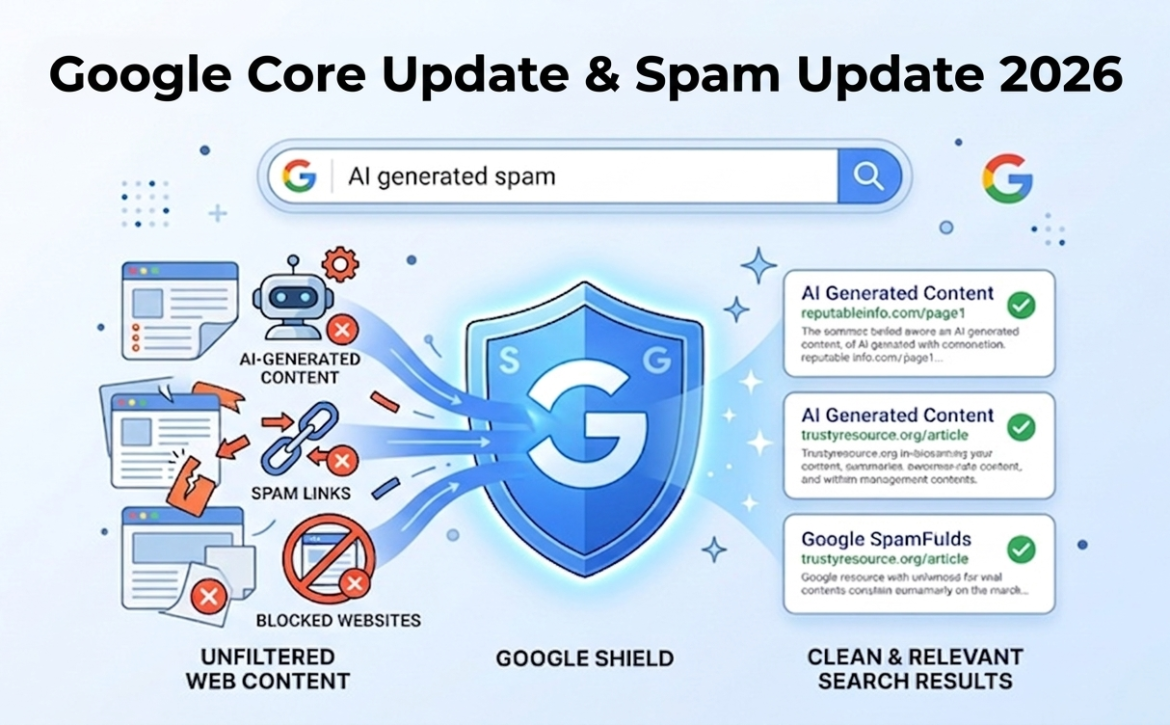
In March 2026, Google introduced a series of major algorithm improvements aimed at improving search quality and removing low value content from search results. These changes focused heavily on identifying manipulative SEO practices, low quality AI generated text, and link schemes that attempt to manipulate rankings. Two major updates played a central role in this transformation: the core update and the spam update. Together, these updates represent Google’s latest effort to maintain trustworthy search results and prioritize authentic, expert driven content.

Why Google Introduced These Updates

Over the past few years, the internet has experienced a massive increase in automated content creation. Many websites began publishing AI generated articles that imitate human writing but lack real knowledge, research, or expertise. While some AI assisted content can be useful, Google identified a growing problem where large volumes of low quality articles were created purely to rank in search results.

This flood of automated digital clutter made it harder for users to find trustworthy information. To solve this issue, Google launched a spam update followed shortly by a broader core update to refine how websites are evaluated in search rankings.

Understanding the Spam Update

The March 2026 spam update specifically targeted websites that rely on manipulative SEO strategies. Google’s algorithm now detects and penalizes sites that publish content designed only to trick search engines rather than help users.

One major target of the spam update was low quality AI generated content. Many sites were producing articles that sounded human but contained shallow information, repeated phrases, or inaccurate details. Google’s systems have improved their ability to recognize these patterns and reduce the rankings of such pages.

Another focus of the spam update was unnatural link building. Some website owners were using private link networks or buying large numbers of backlinks to artificially increase their authority. The update also addressed parasite SEO tactics where third parties publish low quality content on high authority websites simply to exploit their ranking power.

Interestingly, the spam update rolled out very quickly compared to typical Google updates. This rapid rollout suggests that Google had already developed strong detection systems and wanted to immediately remove harmful content from search results.

What the Core Update Changes

After the spam update, Google introduced a broader core update designed to improve overall search rankings. While the spam update focuses on removing harmful practices, the core update focuses on improving how Google evaluates useful and trustworthy content.

The core update analyzes multiple signals related to expertise, experience, authority, and trustworthiness. Websites that provide original research, expert insights, and helpful information are more likely to benefit from this update.

Many legitimate websites that previously struggled to compete against spam heavy competitors may begin to see ranking improvements after the core update settles. This update helps ensure that high quality content receives the visibility it deserves.

Impact on Website Owners and SEO Professionals

These updates send a clear message to website owners and SEO professionals. Shortcuts and manipulative tactics are becoming increasingly ineffective. Google’s algorithms are evolving quickly and can now detect patterns that previously slipped through the cracks.

Websites relying on automated content generation without human expertise may experience ranking losses due to the spam update. Similarly, sites using aggressive backlink schemes or parasite SEO strategies risk losing search visibility.

On the other hand, websites that focus on original content, genuine expertise, and helpful user experiences may see positive gains from the core update.

How to Adapt to the New Algorithm Changes

To succeed after the March 2026 updates, website owners should prioritize quality over quantity. Content should demonstrate real knowledge, practical experience, and clear value for readers.

Instead of publishing hundreds of automated pages, businesses should focus on well researched articles that answer real user questions. Natural backlinks from reputable sources are also far more valuable than large quantities of low quality links.

Another important step is to maintain transparency. Clearly showing author expertise, citing credible sources, and providing accurate information helps build trust with both users and search engines.

The Future of Search Quality

The March 2026 updates highlight Google’s ongoing mission to improve the web ecosystem. By targeting spam tactics and rewarding authentic expertise, Google aims to make search results more useful for everyone.

The spam update removes manipulative and automated content that pollutes search results, while the core update improves Google’s ability to recognize valuable, trustworthy information.For website owners who focus on real value and genuine expertise, these updates may ultimately create a fairer and more reliable search environment. As Google continues refining its algorithms, the long term success of any website will depend on authenticity, quality, and user trust.


How Technology Is Changing the Way Designers Create Visual Content

Technology has transformed nearly every creative industry, and graphic design is no exception. Over the last decade, rapid advancements in digital tools, artificial intelligence, automation, and cloud based platforms have significantly changed how designers create visual content. What once required hours of manual work can now be completed in minutes with the help of advanced software and smart design tools.

For designers, this shift has opened new opportunities to work faster, collaborate more effectively, and produce highly engaging visual content across multiple digital platforms.

The Rise of Advanced Design Software

Modern design software has dramatically improved the way designers approach visual creation. Tools like vector editors, photo editing platforms, and layout software now offer powerful features that simplify complex design tasks. These tools allow designers to manipulate images, typography, and graphics with incredible precision.

Many platforms also include templates, automation features, and real time previews that help designers quickly test different design concepts. This speeds up the creative process while maintaining high quality results. As a result, designers can focus more on creativity rather than spending excessive time on technical tasks.

Artificial Intelligence in Graphic Design

Artificial intelligence is one of the most influential technologies reshaping the design industry. AI powered tools can now generate layouts, suggest color palettes, recommend fonts, and even create complete visual compositions.

These tools analyze design patterns, user behavior, and large datasets to provide intelligent suggestions. Designers can use AI as a creative assistant that speeds up brainstorming and ideation. Instead of replacing designers, artificial intelligence enhances their capabilities and helps them produce innovative designs more efficiently.

Cloud Based Collaboration

One of the biggest changes technology has introduced is cloud based collaboration. Designers are no longer limited to working on a single device or sharing large files through complicated processes.

Cloud design platforms allow multiple team members to work on the same project simultaneously. Designers, developers, and clients can review and comment on designs in real time. This improves communication and ensures that projects move forward quickly without delays.

Cloud storage also provides secure access to design assets from anywhere in the world. Whether working remotely or collaborating across different time zones, teams can stay connected and maintain efficient workflows.

Automation and Design Efficiency

Automation has significantly reduced the time required for repetitive design tasks. Many design tools now include automated features such as resizing graphics for different platforms, generating multiple layout variations, and organizing design assets.

For example, a designer creating content for social media may need to produce the same graphic in several different sizes. Automation tools can instantly generate these variations, saving hours of manual work.

This efficiency allows designers to focus on strategy, creativity, and storytelling rather than repetitive production work. Automation also helps maintain consistency across branding and marketing materials.

The Influence of Data Driven Design

Technology has also introduced data driven design strategies. Designers can now use analytics and user behavior data to guide their creative decisions. This approach helps ensure that visual content not only looks appealing but also performs effectively.

For example, designers can analyze which colors, layouts, or typography styles generate higher engagement rates on websites or social media platforms. This data allows them to refine their designs and create visuals that better connect with audiences.

3D Design and Motion Graphics

Advancements in technology have expanded the possibilities of visual storytelling through 3D graphics and motion design. Designers now have access to tools that allow them to create immersive animations, interactive graphics, and realistic 3D visuals.

Motion graphics have become especially important for digital marketing, video content, and user interfaces. Animated visuals capture attention more effectively than static images and help communicate complex information in a clear and engaging way.

Similarly, 3D design technology allows brands to create visually stunning product displays, advertisements, and virtual experiences.

The Growth of Responsive Design

With the increasing use of smartphones, tablets, and multiple screen sizes, responsive design has become essential. Technology enables designers to create visuals that automatically adapt to different devices and platforms.

Responsive design tools allow designers to preview how graphics will appear on various screens before publishing them. This ensures that visual content remains consistent and visually appealing regardless of where it is viewed.

As digital consumption continues to grow, responsive design technology will remain a critical part of the creative process.

The Future of Design Technology

The future of graphic design will continue to evolve as new technologies emerge. Artificial intelligence, augmented reality, and immersive digital experiences will likely play an even greater role in visual content creation.

Designers who embrace these technologies will gain a competitive advantage in the creative industry. By combining technical tools with human creativity, designers can produce more impactful and engaging visual experiences.

By combining creative design practices with modern digital tools, companies like Achyutam Technology are playing an important role in shaping how businesses create and distribute visual content in the technology driven era.

Complete Ecommerce SEO Strategy for Success 

Ecommerce SEO Growth Strategy: A Complete Guide to Building a Successful Online Store 

Ecommerce is evolving faster than ever. Changing customer behavior, new technologies, and digital platforms are reshaping how people discover and buy products online. To stay competitive, businesses must focus on search visibility, user experience, and data-driven marketing strategies. 

Modern ecommerce success is not just about selling products it is about creating optimized experiences that attract high-intent customers and convert them into loyal buyers. 

Industry experts highlight that ecommerce growth depends on optimizing SEO, content, internal linking, and platform innovation to stay competitive in a rapidly changing market. 

Understanding Ecommerce SEO: The Foundation of Online Growth 

Ecommerce SEO refers to optimizing online stores so that product and category pages rank higher in search engines. Unlike traditional websites, ecommerce platforms must optimize thousands of pages while maintaining performance and relevance. 

Key elements of ecommerce SEO include: 

  • Product page optimization 
  • Category page structure 
  • Technical SEO 
  • Internal linking 
  • Content strategy 

1. Optimize Product Pages for Search and Conversions 

Product pages are the most important assets in an ecommerce website. A well-optimized product page should include: 

  • Clear product titles and descriptions 
  • High quality images 
  • Structured data markup 
  • Customer reviews and ratings 
  • SEO-friendly URLs 

AI-driven search engines and traditional search engines both rely on product data to understand relevance and intent. 

When product pages are optimized properly, they attract users who are ready to buy. 

2. Build a Strong Site Structure and Internal Linking 

A clear site structure helps both users and search engines navigate your store easily. 

Best practices include: 

  • Logical category hierarchy 
  • SEO friendly navigation 
  • Internal links between related products and categories 

Experts recommend improving internal linking and content strategy to strengthen ecommerce SEO and user experience. 

A strong structure improves crawlability and boosts rankings across the website. 

3. Create High Value Content for Ecommerce 

Content is no longer optional for ecommerce brands. Informational content helps attract users in the research stage, while commercial content drives conversions. 

Effective ecommerce content includes: 

  • Buying guides 
  • Blog articles 
  • Comparison pages 
  • FAQs 
  • Tutorials 

Strategic content helps ecommerce brands connect with customers and adapt to evolving expectations.  

4. Leverage Ecommerce Platforms and Technology 

Modern ecommerce platforms like Shopify, WooCommerce, and BigCommerce offer tools that enhance performance and customer experience. 

Key technologies shaping ecommerce include: 

  • Personalization engines 
  • AI-driven recommendations 
  • Shopping graphs 
  • Data analytics tools 

Technology-driven optimization helps brands deliver faster, smarter, and more personalized shopping experiences. 

5. Focus on User Experience and Conversion Rate Optimization 

SEO alone is not enough. Ecommerce success depends on how users interact with your website. 

Important UX factors include: 

  • Fast page speed 
  • Mobile responsiveness 
  • Simple checkout process 
  • Clear call-to-action buttons 

When user experience improves, conversion rates increase significantly. 

6. Adapt to Changing Consumer Behavior 

Online shoppers expect seamless, personalized, and fast experiences. Their expectations are constantly evolving due to digital trends and technology. 

Research shows that ecommerce continues to evolve due to changing consumer behavior, technological advancements, and marketing trends. 

Brands that understand customer behavior can design strategies that increase engagement and retention. 

7. Use Data and Analytics for Ecommerce Growth 

Data-driven decision making is essential for scaling ecommerce businesses. 

Key metrics to track: 

  • Organic traffic 
  • Conversion rate 
  • Average order value 
  • Customer lifetime value 
  • Bounce rate 

Using data helps businesses identify opportunities and optimize their marketing strategies. 

8. Prepare for the Future of Ecommerce and AI Search 

AI-powered search and personalization are transforming ecommerce discovery. Online stores must prepare for: 

  • AI-driven product recommendations 
  • Voice search 
  • Visual search 
  • Multimodal content 

The future of ecommerce belongs to brands that combine SEO, technology, and customer centric strategies. 

Conclusion: Building a Sustainable Ecommerce Growth Strategy 

Ecommerce success is not achieved overnight. It requires a combination of SEO optimization, content marketing, technology adoption, and customer experience improvement. 

Brands that invest in structured SEO, high-quality content, and innovative technology will dominate search results and customer attention. 

In today’s competitive digital landscape, ecommerce businesses must move beyond traditional marketing and adopt a holistic growth strategy that focuses on visibility, trust, and long-term customer value. 

How to Optimize Your Website for AI Search and LLM Visibility in 2026

Search is no longer limited to Google rankings. Today, AI-powered systems like ChatGPT, Gemini, Perplexity, and other large language models (LLMs) are transforming how people discover information. Instead of showing links, AI tools provide direct answers, summaries, and recommendations.

To stay visible in this new ecosystem, businesses must optimize not only for traditional SEO but also for AI search and LLM understanding. This strategy is often called AI SEO, AEO (Answer Engine Optimization), or GEO (Generative Engine Optimization).

Modern LLMs rely heavily on search engines and trusted sources to generate answers, meaning strong SEO fundamentals are still essential for AI visibility.

This guide explains practical strategies to help your brand appear in AI search results and improve LLM visibility.

1. Build Clear and Structured Content for AI Understanding

AI models analyze content differently than humans. They prefer clear structure, logical flow, and direct answers.

Best Practices

  • Use descriptive headings and subheadings
  • Write simple, precise explanations
  • Create dedicated pages for different audiences and use cases

Brands that map content to specific audiences and use cases are better positioned for personalized AI search results.

2. Strengthen Brand Signals Across the Web

AI systems learn about brands from multiple sources such as websites, media coverage, blogs, and social platforms.

Why This Matters

  • Consistent brand mentions help LLMs recognize your authority
  • High-quality publications improve credibility
  • Strong brand narratives influence how AI describes your business

Experts estimate that hundreds of documents may be needed to meaningfully shape how an LLM perceives a brand.

3. Optimize Your Homepage for AI Search

Your homepage is one of the most important signals for AI systems.

What to Include

  • Who you serve
  • What you offer
  • Industries and solutions

LLMs parse homepage content more easily than navigation menus, so clarity is essential.

4. Use Multimodal Content to Increase AI Visibility

AI models pull information from text, videos, images, podcasts, and social posts.

Content Types to Create

  • Blogs and guides
  • Videos and tutorials
  • Infographics and visuals
  • Podcasts and webinars

Repurposing content across multiple formats increases brand recognition in AI-generated answers.

5. Publish Fresh and High-Quality Content

AI search systems prioritize recent and relevant information.

Key Points

  • Update content with meaningful improvements
  • Avoid fake content refreshes
  • Focus on real value

Recent content often performs better in AI search because LLMs prefer up to date sources.

6. Build Authority Through Trusted Platforms

Authority is one of the strongest ranking factors in AI search.

How to Build Authority

  • Publish content on reputable industry websites
  • Earn mentions from high-authority sources
  • Participate in niche communities

Publishing on respected platforms can lead to rapid inclusion in AI generated responses.

7. Leverage Social Media for Faster AI Indexing

Social platforms are increasingly used by AI models as information sources.

Platforms That Matter

  • LinkedIn
  • YouTube
  • Reddit
  • Industry forums

Content on social platforms can appear in AI search results within hours or even minutes.

8. Create Strong FAQ and Q&A Content

AI models love question-based content because it matches user intent.

Best Practices

  • Write detailed FAQs
  • Answer real user questions
  • Avoid hiding FAQs in collapsible sections

Visible and comprehensive FAQs help AI systems understand expertise and relevance.

9. Combine SEO and AI Optimization Strategies

AI optimization does not replace SEO it enhances it.

Core SEO Elements Still Matter

  • Technical SEO
  • High-quality backlinks
  • Content relevance
  • User experience

AI systems rely on search engines, so appearing in traditional search results is essential for AI visibility.

10. Focus on Long-Term Strategy, Not Shortcuts

There is no single trick to dominate AI search.

Sustainable Approach

  • Build real authority
  • Publish valuable content consistently
  • Adapt to evolving AI algorithms

Short-term hacks may work temporarily, but long-term success requires proven SEO and content strategies.

Conclusion: The Future of Search Is AI-Driven

AI search is not replacing SEO it is redefining it. To succeed in 2026 and beyond, businesses must combine traditional SEO with AI-focused content strategies.

By creating structured content, strengthening brand authority, leveraging multimodal media, and maintaining fresh, high-quality information, you can significantly improve your visibility in AI-generated search results.

Brands that adapt early to AI search optimization will gain a competitive advantage, while those that ignore it risk disappearing from the future of search.

How Google’s AI Mode Will Transform Search Experiences in 2026

Search is entering a new phase in 2026, driven by rapid advances in artificial intelligence that fundamentally change how information is discovered, understood, and delivered. AI Mode represents a major shift from traditional search formats toward more intelligent, conversational, and intent-driven experiences. Instead of displaying a list of links that users must explore one by one, AI Mode focuses on understanding questions deeply and presenting meaningful answers in a clear and structured way. This transformation is not just a technical upgrade. It reshapes user expectations, content creation, and how businesses must approach visibility in search.

The Shift From Keyword Search to Intent Understanding

For many years, search relied heavily on keywords. Users typed short phrases and search systems matched those words to relevant pages. In 2026, this approach is no longer sufficient. AI Mode prioritizes understanding the intent behind a query rather than matching exact terms. It evaluates context, language patterns, and implied needs to deliver responses that feel natural and complete.

How AI Understands Complex Queries

AI Mode can interpret long, multi-layered questions that traditional search engines could not process efficiently. It analyzes the context of words, user history, and related topics to generate answers that are accurate and meaningful.

Benefits of Intent-Driven Search

This intent-focused approach allows users to communicate naturally without adjusting their language for search engines. It also encourages businesses to structure content in a way that directly addresses the questions users are likely to ask.

Conversational Search Becomes Standard

One of the most noticeable changes AI Mode brings is conversational search. Users can ask follow-up questions without starting over. Each interaction builds on the previous one, creating a continuous flow of information. This makes search feel more like a dialogue rather than a one-time action.

In 2026, this conversational approach reduces friction and saves time. Users no longer need to open multiple pages to piece together answers. AI Mode organizes information logically and presents it in a way that aligns with how people naturally think and learn. This shift increases engagement and satisfaction, especially for research-driven and decision-based searches.

Richer and Contextual Results

Traditional search results often required interpretation. Users had to decide which link was trustworthy and which content best matched their needs. AI Mode changes this by synthesizing information from multiple sources and presenting a cohesive response.

In 2026, search experiences focus on clarity and relevance. AI Mode highlights key points, explains concepts in simple language, and adapts responses based on the depth of the query. For beginners, it provides straightforward explanations. For advanced users, it delivers more detailed insights. This adaptability makes search more inclusive and effective across different user skill levels.

Changing User Expectations

As AI Mode becomes more widespread, user expectations evolve. People expect faster answers, clearer explanations, and more personalized responses. Waiting to scroll through pages of results feels outdated. AI-driven search sets a new benchmark for speed and usefulness.

Users also expect search to anticipate their needs. AI Mode analyzes patterns and context to suggest related information that users may not have considered. This proactive approach transforms search into a discovery tool rather than just a lookup function. In 2026, users rely on search not only to answer questions but also to guide decisions.

Impact on Content Creation

The rise of AI Mode places greater importance on content quality. Shallow or repetitive content struggles to stand out in an environment where AI evaluates depth, clarity, and usefulness. In 2026, content must demonstrate real value to be included in AI-generated responses.

Redefining Visibility in Search

Visibility in 2026 looks very different from traditional rankings. Instead of competing for a position on a results page, the goal becomes inclusion within AI-generated answers. Being visible means being recognized as a reliable source of information that adds value to the conversation.

This shift changes how success is measured. Traffic alone is no longer the only indicator of performance. Influence, credibility, and relevance within AI responses become equally important. Businesses and content creators must adapt by aligning their strategies with how AI interprets and presents information.

Opportunities Created by AI Mode

While AI Mode presents challenges, it also opens new opportunities. Brands that invest in meaningful content and clear communication can earn citations within AI responses. High-value content that answers complex questions, offers unique insights, and integrates structured information will gain visibility.

Preparing for the AI-Driven Search Future

As we approach 2026, businesses should embrace AI-centric optimization. This includes structuring content for clarity, anticipating user questions, and prioritizing depth and relevance over volume. Measuring success now also involves tracking how content is referenced in AI responses, not just clicks or traditional traffic metrics.

Conclusion

Google’s AI Mode is transforming search into a conversational, intent-focused, and highly contextual experience in 2026. Users expect faster answers, deeper insights, and personalized responses. Businesses that adapt content strategies to meet these expectations will thrive in this new era. Achyutam Technology is ready to help businesses navigate these changes and succeed in the AI-driven search landscape of 2026.

How the SEO Company Helps Dentists Get More Patients Online

In this digital era, patients do not look for dentists through referrals only. Rather, they look through digital platforms using searches such as ‘best dentist near me’ or ‘best dental clinic in my area.’ If your practice fails to appear on the first page of search engines, then you are losing customers to your rivals. This is where it becomes imperative to engage the best dental SEO services. At Achyutam Technology, we have expertise in enhancing your online presence through our services.

What Is Dental SEO and Why Does It Matter?

Dental SEO (Search Engine Optimization) is a professional digital marketing process that is specifically designed for dental practices. Dental SEO is all about optimizing your website to increase your visibility on dental-related searches on the internet, on search engines like Google.

An Expert Dental SEO Approach benefits:

Boost web presence

Drive targeted local traffic

Establish trust and credibility

Encourage more appointment scheduling.

With the absence of proper search engine optimization, the greatest quality dental care may very well go unseen on the web.

Benefits of Hiring the Best Dental SEO Company

1. Higher Search Engine Rankings

The best dental SEO company understands how search engines work. From keyword research right through to on-page optimisation; expert SEO will ensure your website ranks higher for high intent keywords. Achyutam Technology focuses on ranking your practice for keywords that bring in actual patients and not ‘just’ traffic.

2. More Local Patients

Dental search is mostly local search. A reputable dental SEO agency maximizes your Google Business Listing, local citations, and geographic terms so your dental practice comes up on local search engine results pages and Google Maps.

3. Increased Website Traffic and Conversions

SEO is not just about traffic it’s about conversions. A professional dental SEO company optimizes website structure, page speed, mobile usability, and content to ensure visitors easily book appointments.

4. Stronger Online Reputation

Online reviews play a major role in patient decision-making. The best dental SEO company helps manage and enhance your online reputation, encouraging positive reviews while maintaining trust and transparency.

Why Choose Us as Your Dental SEO Partner?

We know the dental business inside and out. We tailor our SEO approach to fit the distinctive needs that exist within a dental practice setting.

We offer:

  • Dental-specific keyword research
  • Local SEO optimization
  • Content marketing for dentists
  • Technical SEO improvements
  • Monthly performance reporting

Conclusion

The ideal dental SEO service is a significant contributor to increasing online patient flow for dentists. Search engine optimization is indeed a growth generator for improving search rankings as well as the number of appointments made online. It is indeed a blessing to have a reliable search engine optimization service partner like Achyutam Technology by the side of a dental clinic.

What Are SEO Breadcrumbs and Why They Matter for Search Rankings

In the current digital era, the need for proper navigation of websites has become paramount in ensuring not only a better user experience but also influencing SEO placement. Among the numerous techniques available to help with this aspect of websites is the SEO Breadcrumbs tool, which has emerged as a key and easy tool to utilize. By offering a well-designed bread crumbs system to a website or a blog, one can significantly affect the structure and ranking of a website in search engine algorithms. In this piece, we will inform readers about the SEO Breadcrumbs tool and its importance in improving the SEO placement of a blog or a website.

What are SEO Breadcrumbs?

SEO Breadcrumbs are a type of secondary navigation menu that provides the user’s current position within the site’s structure by showing links between the current page and the home page of the website. Breadcrumbs usually are placed at the top part of the webpage and help the user trace back how they arrived at the current page on the website. Taking an e-commerce website, an example of breadcrumbs for the products page could look something like this: Home > Electronics > Mobile Phones > Smartphones.

  • Important Points Regarding SEO Breadcrumbs:
  • Assist users in determining their location in the site hierarchy
  • Specify signal relations between the pages that you want search engines to discover.

Unlike other primary menu options, breadcrumbs are not a replacement option for users because breadcrumbs work as a complementary element to help users navigate associated areas without necessarily going back. Breadcrumbs also offer additional information to search engines to improve the process of being indexed.

Breadcrumb Navigation Purpose

The primary function of breadcrumbs is to enhance site navigation and help in making the site easier to understand. When sites are large with a multitude of categories or levels of information, it may confuse visitors. Breadcrumbs help such visitors by acting as a roadmap that guides them with exact locations and ways to navigate back to previous pages at higher levels.

Breadcrumbs facilitate in cutting down bounce rates as well. People reaching the deep pages of a website, courtesy of search engines, can easily navigate other portions of it instead of bouncing back. It is an ideal aspect with regard to user experience, besides helping in boosting the search engine ranking due to increased session times.

Further, breadcrumbs increase site accessibility. This assists in forming a reliable navigation tool that enables visitors with different browsing behaviors, including those who use smartphones, to navigate the site.

Varieties of Breadcrumbs

It’s essential to understand the various types of breadcrumbs to ensure that you use the most suitable approach on your website.

Hierarchy-Based Breadcrumbs: This kind of breadcrumb shows the architecture of a website that leads from broad topics to internal pages. This kind of breadcrumb is the most SEO-optimal when considering search engine rankings.

Attribute-based breadcrumbs: These type of breadcrumbs are commonly used in e-commerce websites and display attributes like size, color, or brand that a user may filter for.

Another type of breadcrumb trail is history-based breadcrumbs, and this type indicates the trail of pages traversed to arrive at a current page. As useful as these may be for user guidance, they can be less useful when the goal is SEO because they do not represent page architecture.

Enhancing User Experience through SEO Breadcrumbs

UX is an essential consideration for current search engines. Breadcrumbs are helpful to visitors as they are able to navigate through large sites efficiently without becoming frustrated. Visitors who can view related articles with only one click are likely to be more engaged.

Secondly, breadcrumbs are beneficial for users with mobile devices because they provide a simple means of navigation through a page without completely depending on menus and buttons. Better navigation can result in:

  • Spending more time on the website
  • Reduces bounce rates
  • More pages viewed during a session
  • Such engagement metrics are considered indirect SEO signals that can lead to enhanced rankings.

Importance of SEO Breadcrumbs to Search Engines

As a search engine, it has been found that knowing how a website is structured can be equally important as knowing what the website has to offer. This is where breadcrumbs can be of immense help.

  • These strengthen page relations and share link authority to a website
  • They assist in determining the pages’ relevance in particular categories.
  • They assist in ranking pages based on their contents.

Often, Google may choose to provide breadcrumbs in the search engine results pages in lieu of complete links. This goes a long way in making SERPs easier to read, ensuring a better user interface, as well as an improvement in the CTR rates of the page.

Structured Data in Breadcrumbs

Structured data, also known as schema markup, increases the SEO power of breadcrumbs. Breadcrumbs with schema markup can result in rich results in search engine result pages. This brings a sense of professionalism to your website. The main reason that differentiates breadcrumbs from other navigation tools is their ability to provide a sense of location.

The structured data will also make it possible for the search engines to correctly understand the paths on the navigation menus. This will be an improvement on the current methods where the search engines could end up assuming links between pages in order to carry out indexing.

Best Practices & Common Pitfalls

For optimal use of breadcrumbs, it is essential to consider the following common mistakes that people make:

  • Moving around on the site using breadcrumbs that do not correspond to the actual site structure
  • Overloading breadcrumbs with a large number of links or keywords
  • Application of inconsistent breadcrumb patterns among various pages

To ensure breadcrumbs are user-friendly as well as SEO-friendly, it is important to keep them simple, clear, and consistent.

Best Practices for Successful Implementation Best Practices for Successful Implementation

For making successful breadcrumbs, it is necessary to follow the following best practices:

  • Keep breadcrumbs towards the top of the page for ease of observation but do not clutter the interface
  • Make sure that each level of breadcrumb leads to an actual page that can be indexed
  • Make breadcrumb trails consistent with the site’s information architecture

Consistency in the entire website

When implemented correctly, breadcrumbs can help with navigation, improve satisfaction with the user experience, and build a solid foundation for SEO.

Conclusion

SEO Breadcrumbs can prove to be a handy tool when it comes to multiplying user experience as well as search engine understanding of website structures. They make things easier to understand and can prove to be a crucial step in website development and improvement. SEO breadcrumbs can even lead to increasing the overall CTR on a website and can prove to be a boost for search engines as well. When it comes to multiplying growth in a business related to SEO breadcrumbs, achyutam technology is a great option to consider.